
You Have to Go In
Why my next book had to be a different one

Værøy, 07.05.26.
The Maelstrom used to be the end of the world. Edgar Allan Poe wrote about it. Jules Verne wrote about it. Jack Sparrow danced through it. I spent every summer of my childhood on this bare island until I was fifteen, Værøy, the Weather Island, separated from the mainland of Lofoten by Moskenesstraumen, the mythological current once thought to mark the world’s edge. Eight years ago I started coming back. I have been silently working on ‘The Maelstrom’ ever since.
We are about to be confronted with a final narcissistic injury. Copernicus took the center. Darwin took our specialness. Freud took our self-mastery. The fourth and final wound will not arrive with sirens or a press conference. It will arrive on a Tuesday. We will simply stop noticing that the smartest entity in any room is no longer one of us. The wound will be sutured before we admit we were bleeding. The lights are on, but no one is home anymore to perceive them.
Our response is what, together with my co-author Dr. Florian Neukart, I named in passing in The Singularity Paradox: we must become it, Artificial Human Intelligence, or AHI. We named it there as a possibility. Today, I am naming it here as a necessity.
Artificial; because the era of simply being human, by accident of birth, is closing. From here forward, being a Mensch is a thing one chooses, repeatedly, against the gravitational pull of a world that no longer requires the choice. To remain human is now an artificial act. A made thing. A construction.
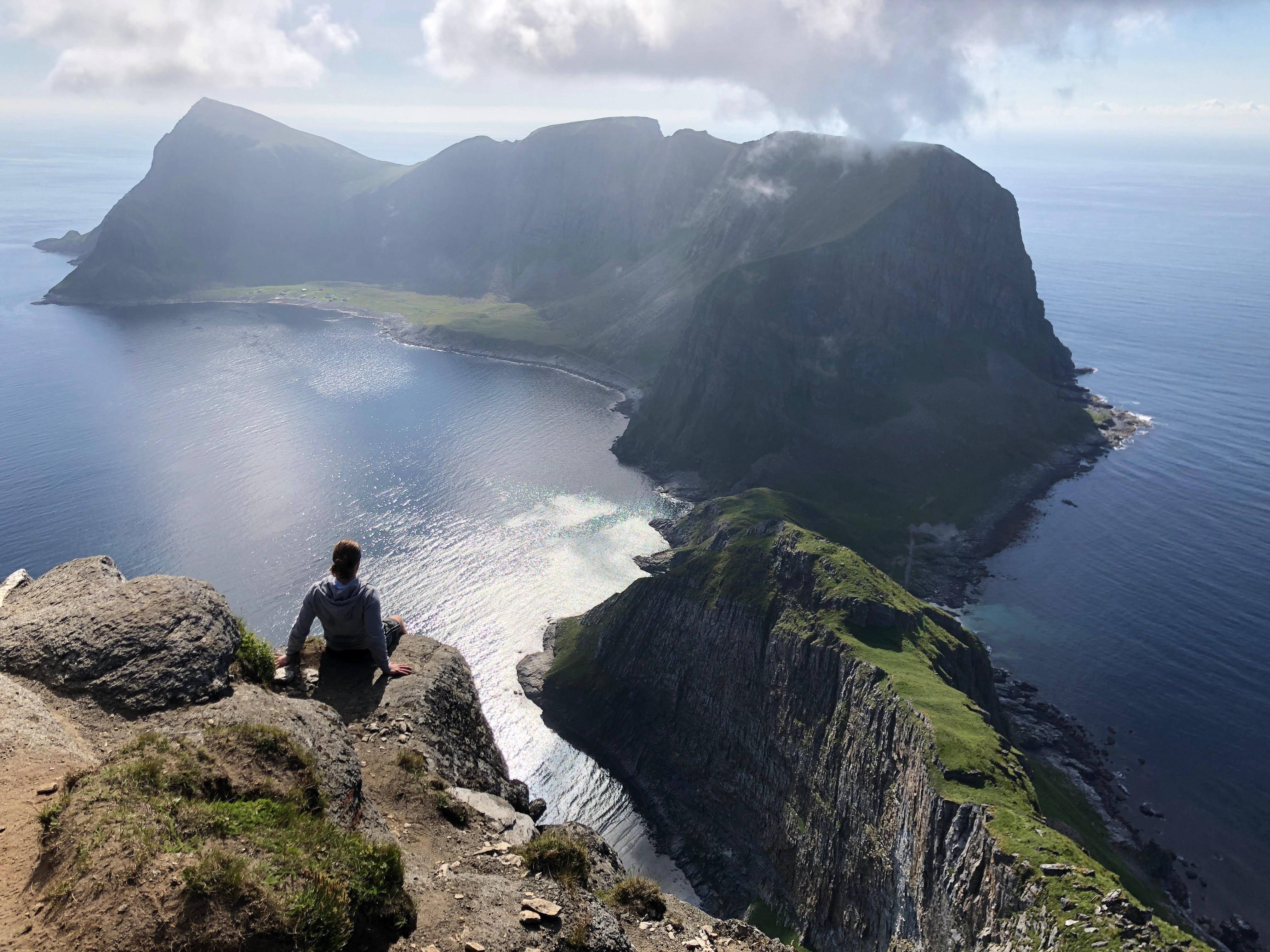
Human; because we refuse to let intelligence be the only thing that matters. The machines are about to be more intelligent than us, significantly so. Fine. They might not, for a long time and possibly ever, possess what David Chalmers called the redness of red, the felt fact that there is something it is like to see, to love, to grieve, to sit at the cliff on Værøy at Norlandssnippen in May and watch the Maelstrom turn. That fact is not a footnote in the philosophy of mind. It is the whole game of what it means to be a Mensch. The only question we will be confronted with is: is that relevant? And to whom, other than myself?
Intelligence; because I am still capable of perceiving my own perception. There is no clean English word for it. The Germans have one: Wahrnehmung der Wahrnehmung. The perception of perception. The thing that distinguishes a living being from a merely functioning one. What it feels like to be something. The thing the machines, however brilliant, might not have. The thing most humans, most of the time, have already stopped using.
This is my answer to the philosophical zombie apocalypse. To become AHI is not to merge with the machines. It is to refuse to merge with our own performance. To stop being the smooth, optimized, well-calibrated, externally-validated version of ourselves that the system rewards.
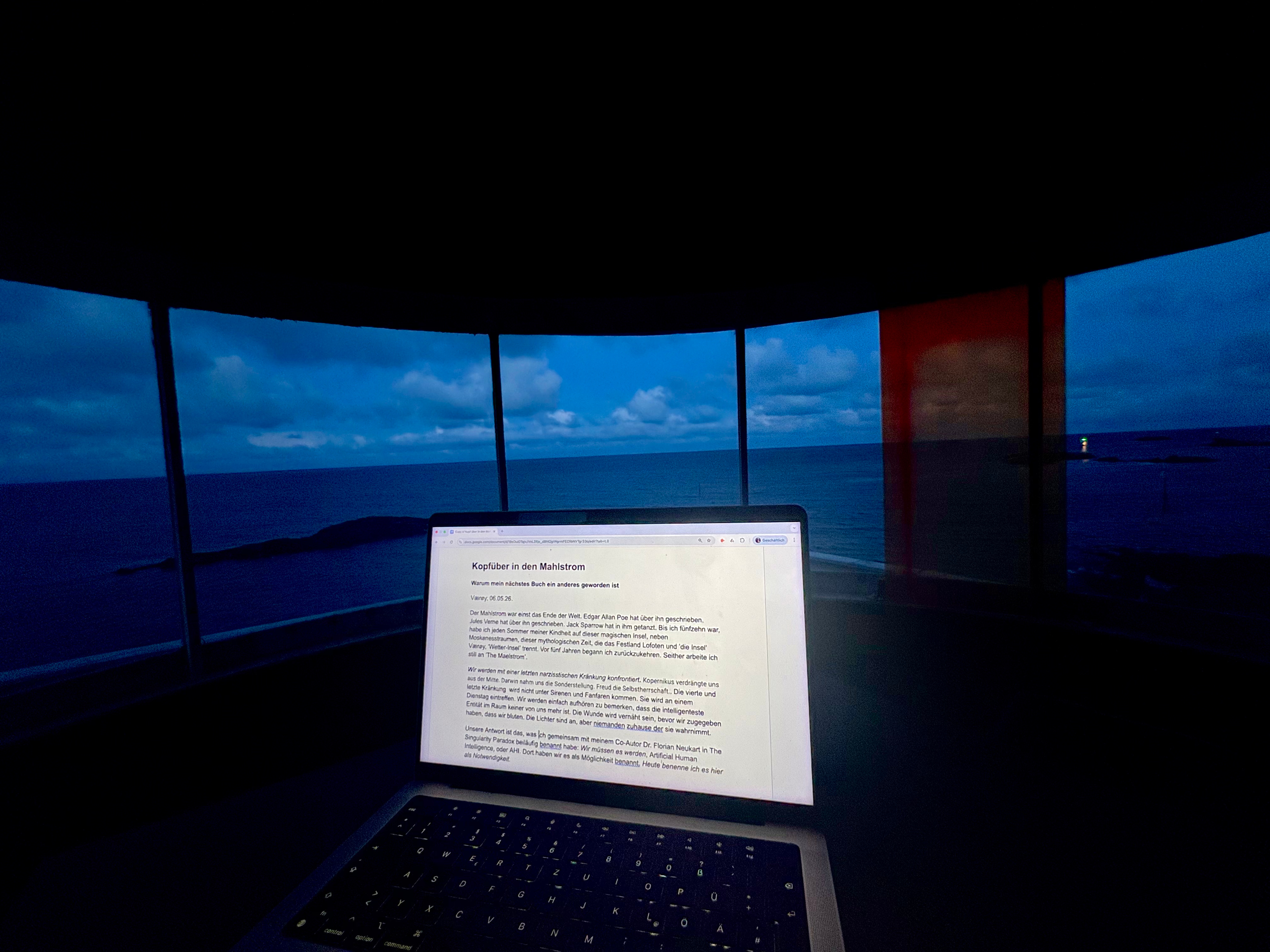
And yet I sit here in the lighthouse, on the southern side of the island, anything but illuminated. Instead of pursuing predictions about quantum technology and the vision of tomorrowmensch, a different flame has caught in me. I have begun, instead, to write a book about the man standing at the edge of the Maelstrom.
The origin? A Wednesday evening. The absence of a conversation. The silence you find when nothing is incoming and you are left alone with what is actually there. A mirror that returns an image most successful men spend decades arranging not to see. The image of someone who writes and speaks about Lebendigkeit, about livingness, and who discovers, on an ordinary evening, what most people in such a position discover sooner or later: that the question has been performed, not lived. No one you have to call. The silence is then not the absence of interruption. It is the absence of anyone, anywhere, who needs you, when you are not performing
The first book I planned was a synthesis. The dance of Sci-Phi at the outskirts of mind and matter. The unification of Mythology and Enlightenment. The Quantum age. All of it true. All of it less urgent than what I now have to write instead.
I have found a sharper way to say what this requires, and again the Germans have it: Streich dich selbst. Strike yourself through. Not finding the self. Removing what was never the self in the first place, the inherited reactions, the borrowed certainties, the performance you mistook for a Mensch, for a person. What is left, after the striking, is not a new identity. It is a room with the noise turned off. And that, finally, is where something can begin to live.
The Maelstrom lives, and it will be my last book. Not because I no longer enjoy writing, and not because writing has stopped being, for me, the purest form of thinking, but because, after this, I simply have nothing more to say. The next book, however, is shorter, harder, and in German first. It is about the recognition I have outlined here in a few paragraphs and that took me more than thirty years to be ready to make. It will be followed by an analytical book with my co-author Florian Neukart, on memory, continuity, and what we are now able to engineer. And only then, finally, will I complete the Maelstrom book that I came to this island to write, which I now understand was always meant to be the last one, because by the time I have written the other two there will be nothing left to add.
I think I may finally be saying what I have been circling for thirty years. The discipline now is to say it, and then to stop.
Some years ago, on this same island, I wrote a line I did not fully understand at the time:
“The ‘Diesseits’, referring to the materialistic perceived reality — the here and now — displays a brutal apathy. If it has a soul, it is cold. If it has a perception, it is absent. It’s ugly, brutal and absurd. However, if you sail full bore into the abyss, the light of vitality will show, and a new beautiful absurdity can emerge. We call it otherworldly (the ‘Jenseits’) — maybe even divine — madness.”
The lighthouse here was built to warn ships away from the Maelstrom. I have been thinking, all week, that this is exactly the wrong instinct.
You have to go in. That is the only place anything is alive.
Værøy, 07.05.26.