
Before the cogito
Why the operating system of modernity has been backwards for four hundred years

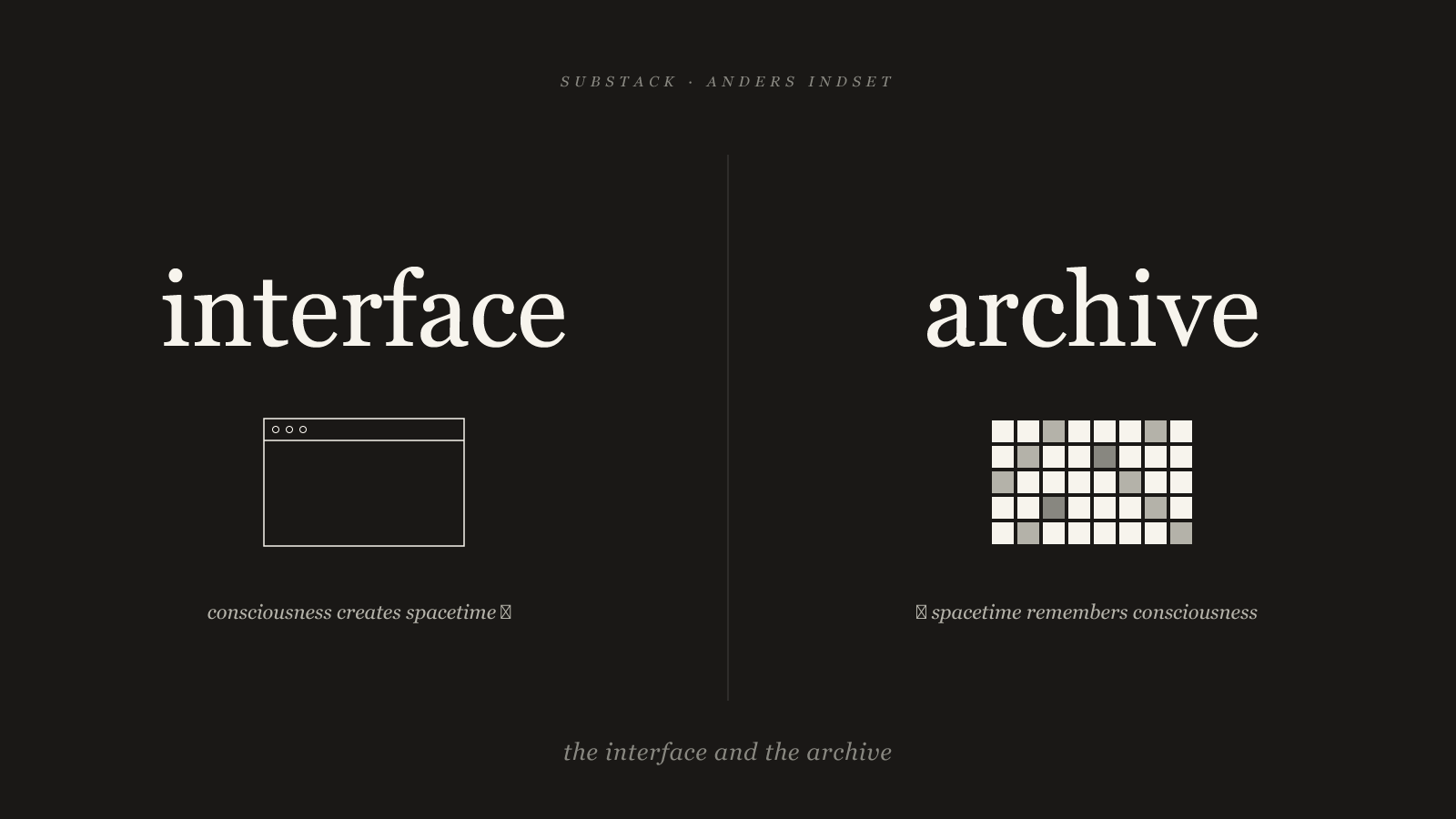
“I am, therefore I can think about thoughts.”
That sentence does not look like a foundational claim. It looks almost trivial, the obvious order of priority, the way things would naturally be described if you weren’t trying to be clever about it. But this sentence, in this order, is heresy.
For four hundred years, the operating system of Western thought has run on the opposite sequence. Cogito, ergo sum. I think, therefore I am. Thinking is the foundation. Being follows from it. Take that sentence seriously, as everyone since 1641 has been forced to, and an entire architecture of mind, body, science, technology, and self-understanding falls into place behind it. Take it apart, reverse the order, and the architecture has to be rebuilt.
I think it has to be rebuilt. And we are living in the moment when it has become not just possible but necessary.
The man who doubted everything
Something happened to me this morning that brought me back to Descartes. I had been half-asleep, gone to bed early yesterday to re-align with European time, in that loose state where the dream and the room are competing for which one is real. The dream had its own gravity, its own logic, its own emotional texture. For the duration of it, indistinguishable from waking. When I finally surfaced, it took a moment to be sure which one I had just left. The doubt that produced was not philosophical. It was felt. Which of these am I in right now?
Descartes did something similar nearly four hundred years ago, and built modern philosophy out of it. He sat down in a small village in Bavaria, passing the winter as a young soldier, and tried to discard systematically every belief that could be doubted. The senses can deceive us. Dreams can feel as real as waking. Mathematics could be the work of an evil deceiver. The external world could be illusion. Other minds could be automata. By the end of his doubting, almost nothing remained.
But one thing did not yield. The doubting itself required a doubter. Of that he was sure. Even if everything he thought was wrong, there must be something doing the thinking that was wrong. From that one indubitable fact, Descartes built the foundations of modern philosophy. Cogito, ergo sum. I think, therefore I am.
It was brilliant. It still is. But the consequences have been costly.
It split mind from body. The thinking thing (res cogitans) became one kind of substance; the extended thing (res extensa) became another. Three hundred years of attempts to reconnect them followed. None have been successful.
It privileged the interior. The thinking subject became the secure inner fortress. The body, the world, other minds, the cosmos itself became external territory that the subject had to reach through inference. The hard problem of consciousness, which David Chalmers gave us back in the 90s, the problem of other minds, the entire project of bridging mind to world: all of these are downstream of one cold Bavarian winter and the geography Descartes drew that day.
It made cognition essence. To be human meant being a thinking thing. Everything else became secondary. The Enlightenment inherited this and ran with it. So did everything after.
And, this is where I want to go with this, it built the foundation for modern artificial intelligence. The AGI project, in its dominant form, is Cartesian to its bones. Find the right algorithms, the right reasoning, the right computational structures, and you will have a mind, regardless of substrate or history. Cognition as substrate-independent. That is Descartes, four centuries later, restated in code.
The challenges that mounted
Others have suggested this picture is wrong. Some of the strongest minds of the last hundred years have been pushing against the cogito from multiple directions.
Heidegger spent his career trying to recover the question of being from beneath the Cartesian floor. Being and Time opens with the claim that we have forgotten what it means to ask what is, because Descartes told us that what does the asking is the foundation. ‘Dasein’, being-there, precedes the thinking subject. The thinking subject is one mode of being among others. It is not the bedrock.
Merleau-Ponty pushed in a different direction, the lived body as precondition for cognition, the body as where mind and world meet. Today, returning to Merleau-Ponty almost feels like a rediscovery to me; this is where I began thinking about AI nearly two decades ago.
Nietzsche, of course some decades earlier, attacked the cogito more bluntly: “I think” already smuggles in a unified thinking subject. There is just thinking, ‘es denkt’, it thinks. Eastern traditions have held versions of this for two and a half millennia; the Buddhist analysis of anatta, no-self, moves in a different direction than I am, but it shares the recognition that the cogito takes more for granted than it has earned.
So before I get attacked, I am in good company. Even looking at the founding fathers of quantum theory, we see their paths winding through eastern philosophy, publishing what I today refer to as “Sci-Phi.” The move is not entirely novel. What might be novel is the formulation, and the reason I think we have finally arrived at the cultural moment in which it has to be made explicit.
The reversal
Here is the move, stated plainly. We are not thinking beings who happen to exist. We are existing beings who happen to think, ‘wir sind seiende Wesen die über das Gedachte reflektieren können’
Being is the precondition. Thought is one of the things being does. The order of priority that Descartes locked in, thinking first, being second, has it precisely backwards. I am, and because I am, I can think about what I am thinking.
Notice what this does. It re-grounds reality in being rather than in cognition. What being turns out to be, embodied life, informational pattern, mechanical structure, something else entirely, becomes an open question, not one pre-decided by Descartes’ choice to start with thought. The reversal does not commit me to any particular substrate. It commits me only to refusing the assumption that thinking comes first.
It does not require abandoning the cogito at Descartes’ level. Yes, if I am thinking, I exist. It denies only that the cogito is foundational. Thinking is downstream, not upstream. The question this immediately raises, and rightly: what is the “I” that is? If “I” is no longer defined as the thinking thing, what is it? This is the question on which everything else in my work depends. I haven’t closed the answer. But I think there is a direction to look.
We are pattern. Briefly coherent in a cosmos that, if certain frameworks in contemporary physics turn out to be right, preserves the information of every event it has ever hosted. The “I” is one of those events. Still in progress. Complex enough to notice itself.
That is the longer answer, and it points toward a project I have been writing toward for several years and will name more directly in pieces still to come. The shorter answer is enough for now.
I am, and because I am, I can reflect on what I think. And this will give us a disconcerting feeling with the next developments of AI.
Why this matters now
If this were a quiet philosophical disagreement, I’d leave it to the stages. It is not. The Cartesian foundation is presently failing in three places at once.
It is failing in physics. The picture of an external world made of substantial things, accessible to a thinking subject who infers from observations, has been under pressure since quantum mechanics arrived a century ago. Information, not substance, looks increasingly like the bottom of the physical world. My co-author Florian Neukart’s work on the Quantum Memory Matrix, which I have been writing about with him, is one of several contemporary attempts to think the foundations of reality in informational rather than substantive terms. None of those frameworks fit comfortably inside the Cartesian architecture.
It is failing in cognitive science. The neurons fire, and then we project what we call reality. The embodied, enactive, ecological, predictive-processing wave of the last two decades has effectively retired the disembodied Cartesian subject as a serious model of how cognition works.
I have spent a lot of time this past year in long conversations with the frontier AI systems. They are extraordinary. Something is happening when I talk with them. But it is not the kind of thing that is happening when I talk with you.
And that is where it is failing most urgently, in artificial intelligence. We have tweeted and X’d, Instagrammed and liked our way into a culture that takes thought-as-substrate for granted. The AGI project, in its dominant form, assumes intelligence is substrate-independent computation. Find the right architecture, run it on enough silicon, and you have a mind. I think this is true when it comes to the output, what will be the result. The question is: is something missing?
I have been arguing for several years that what we should aim for is not AGI in this Cartesian sense, but something different. Artificial Human Intelligence, AHI. And what AHI must preserve, more than embodiment or evolutionary continuity or any specific substrate, is the perception of one’s own perception. The recursive self-noticing that lets thinking think about thinking. The thing current AGI architectures, however powerful their output, do not yet have. That is what is missing. Not intelligence. Not capability. Self-perception. I am not saying AGI should have it. I am saying that I want it, for myself, subjectively. I want to keep this agency. To remain a Mensch, not a Maschine. That is why we have to understand it before we build past it.
In all three places, the operating system Descartes installed is failing. The patches no longer hold. We don’t need another patch. We need to reinstall from a different foundation. That foundation is being. Not thought. Being.
A note for the careful reader
Some will say it’s a rearrangement of words. Same content, different order. I disagree. The order is the architecture. Descartes did not just put thinking before being grammatically. He built a four-hundred-year tradition in which thinking founds being, and everything else has to be argued back into reality from there.
To put being first is to refuse that founding. It is to insist that we are already in a world before we think about it, already embedded in something before we abstract ourselves out of it. That is the move on which everything else I am building depends.
The next pieces in this thread of work are coming. The framework that names this view directly will be published in due course. Florian and I will be on Mountain View pondering some new publications tomorrow. For now, I’m leaving you with the door. When you next catch yourself thinking, notice that you are also breathing. Also somewhere. Also alive in a cosmos that, by some accounts I find increasingly persuasive, has been recording every event of which you are a part. The thinking is real. So is everything else. Descartes asked us to start with one of them.
I am asking us to start with all of them.
Or as I’d put it in German: ‘wir sind seiende Wesen die über das Gedachte reflektieren können’. We are not thinking beings who happen to exist. We are existing beings who happen to think. And the difference matters.
Some of our thoughts come to our mind independently of our will. Who thought them in these cases?